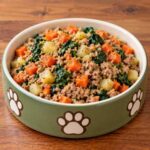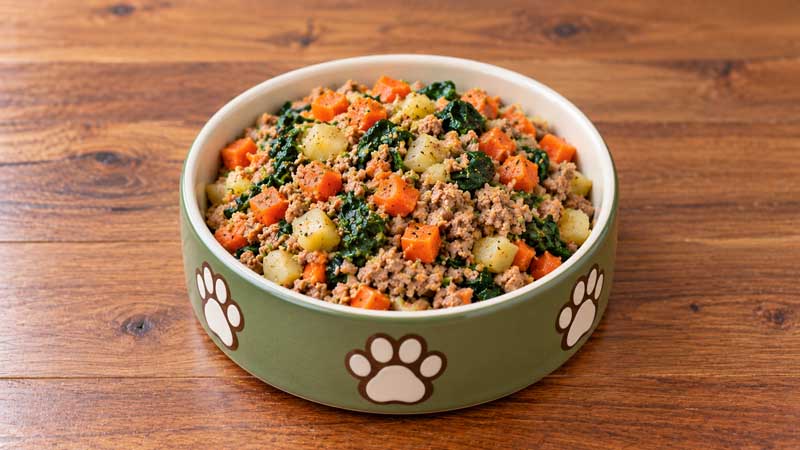
This homemade grain-free dog food recipe combines ground chicken, chicken livers, eggs, fresh vegetables, apples, and sunflower oil to create a protein-rich meal for dogs.
The ingredients are cooked together and mixed with finely ground eggshells as a natural calcium source. The recipe takes approximately 50 minutes to prepare and cook, producing 10 one-cup servings.
Important: Although this recipe contains several nutritious ingredients, it has not been verified as a complete and balanced diet for dogs.
Consult a veterinarian or board-certified veterinary nutritionist before using it as your dog’s regular food, particularly to confirm its calcium, phosphorus, vitamin, and mineral balance.
Recipe Overview
- Prep Time: 25 minutes
- Cook Time: 25 minutes
- Total Time: 50 minutes
- Servings: 10
- Serving Size: Approximately 1 cup
- Cooking Method: Stovetop and oven
- Dietary Style: Grain-free
Ingredients
Protein and Healthy Fats
- 3 pounds ground chicken
- 6 ounces chicken livers, chopped
- 6 large eggs
- 3 tablespoons sunflower oil
Vegetables and Fruit
- 4 medium carrots, peeled and chopped
- 2 apples, peeled, cored, and chopped
- 4 cups fresh baby spinach
- 1/4 cup water
Calcium Supplement
- Reserved eggshells from the 6 eggs
Equipment Needed
- Oven and baking sheet
- Large skillet with a lid
- Medium saucepan with a lid
- Coffee grinder or mortar and pestle
- Potato masher
- Mixing bowl
- Airtight food storage containers
Instructions
1. Prepare the Eggshell Calcium Powder
Preheat the oven to 350°F (175°C). Crack the eggs into a bowl and reserve the liquid for the meat mixture. Rinse the empty eggshells thoroughly to remove any remaining egg residue.
Arrange the shells on a baking sheet and bake for 5–7 minutes, or until completely dry. Allow them to cool, then grind them into a very fine powder using a clean coffee grinder or mortar and pestle.
The amount of eggshell powder should be determined by a veterinary nutritionist to ensure the finished food contains an appropriate calcium-to-phosphorus ratio. Do not assume that using all the shells automatically provides the correct amount of calcium.
2. Cook the Carrots and Apples
Place the chopped carrots and apples in a saucepan with the water. Bring the mixture to a boil, then cover the pan and reduce the heat to low.
Simmer for 10–15 minutes, or until the produce is soft enough to mash easily. Check occasionally to ensure the water has not completely evaporated. Add a little more water if needed to prevent sticking.
3. Cook the Chicken and Liver
Heat a large skillet over medium heat. Add the ground chicken, chopped chicken livers, reserved eggs, and sunflower oil.
Cook for approximately 5–7 minutes, stirring and breaking up the meat into small pieces. Continue cooking until the chicken is fully cooked, the liver is no longer pink, and the eggs are set. Use a food thermometer to verify that the poultry reaches an internal temperature of 165°F (74°C).
Avoid adding salt, onion, garlic, or other seasonings that may be unsuitable for dogs.
4. Add the Spinach
Spread the baby spinach over the cooked meat mixture. Cover the skillet and steam for approximately 5 minutes, until the leaves have wilted and softened.
Stir the spinach into the meat to distribute it evenly. If the skillet is too dry, add a small amount of water to prevent the ingredients from sticking.
5. Mash the Cooked Produce
Transfer the softened carrots and apples to a bowl. Use a potato masher to break them down into a soft, chunky mixture.
Remove any remaining apple seeds and cores, and make sure no hard pieces remain. Apple seeds should not be included in your dog’s food.
6. Combine the Ingredients
Add the mashed produce to the skillet containing the chicken, liver, eggs, and spinach. Add the prepared eggshell powder only in the amount prescribed by your veterinarian or nutritionist.
Stir thoroughly until all the ingredients are evenly distributed. Allow the mixture to cool before dividing it into individual portions.
Serving Guidelines
Serve the food at room temperature or slightly warmed, depending on your dog’s preference. If using a microwave, heat a portion briefly, stir well to distribute the heat, and check the temperature carefully before offering it to your pet.
The suggested one-cup serving is a recipe yield measurement, not a recommended daily feeding amount.
The appropriate quantity depends on your dog’s weight, age, activity level, health, and overall calorie requirements. Introduce any dietary change gradually and monitor your dog’s appetite, stool, and tolerance.
Food Safety and Storage
Refrigeration
Transfer the cooked food into clean, airtight containers and refrigerate promptly after preparation. Keep only a short-term supply in the refrigerator, and follow your veterinarian’s or food-safety professional’s recommended storage period.
Freezing
Divide the remaining food into meal-sized portions and freeze in suitable airtight containers. Label each container with the preparation date and contents.
Thaw frozen portions in the refrigerator rather than at room temperature. Use thawed food promptly and discard any portion that has been left out for too long or shows signs of spoilage.
Reheating
Warm only the portion you intend to serve. Stir thoroughly to avoid hot spots, and allow the food to cool to a safe temperature before feeding. Do not repeatedly heat and cool the same portion.
Important Ingredient and Nutrition Considerations
- Chicken: Provides protein and essential amino acids. Cook it thoroughly and remove any bones.
- Chicken liver: Supplies protein and several vitamins and minerals, but excessive liver can contribute to excessive vitamin A intake.
- Eggs: Add protein and other nutrients. Cook them fully before feeding.
- Sunflower oil: Provides linoleic acid, an essential omega-6 fatty acid for dogs. The appropriate quantity depends on the overall fat and fatty-acid balance of the diet.
- Carrots and spinach: Supply fiber and various micronutrients. They should be prepared in a form your dog can comfortably digest.
- Apples: Provide fiber and carbohydrates. Remove the core and seeds, and serve only the flesh.
- Eggshell powder: Contains calcium, but the quantity must be balanced against the phosphorus supplied by the meat and other ingredients.
A grain-free recipe is not necessarily nutritionally complete or more suitable for every dog. Dogs have individual dietary needs, and a homemade meal intended for long-term feeding should be formulated to meet recognized canine nutritional standards.
Nutrition Facts Per Serving
The following figures are the supplied estimates for one serving, assuming the finished recipe is divided into 10 equal portions. Actual values may vary depending on ingredient brands, fat content, cooking losses, and final yield.
| Nutrient | Amount |
|---|---|
| Calories | 291 kcal |
| Protein | 37 g |
| Total Fat | 12 g |
| Saturated Fat | 3 g |
| Cholesterol | 242 mg |
| Total Carbohydrate | 7 g |
| Dietary Fiber | 2 g |
| Total Sugars | 4 g |
| Sodium | 144 mg |
| Potassium | 490 mg |
| Iron | 3 mg |
| Vitamin C | 9 mg |
| Calcium | 52 mg |
These figures are not a validated canine nutritional analysis and should not be used to determine whether the recipe meets your dog’s daily requirements.
A veterinary nutritionist can calculate the finished recipe’s nutrient profile and adjust the ingredients and supplements to suit your dog’s needs.
Final Notes
This homemade grain-free dog food recipe offers a straightforward way to prepare a cooked mixture of chicken, liver, eggs, and fresh produce. Careful cooking, appropriate portioning, and safe storage help make preparation more convenient.
Before serving it as a complete daily diet, have the ingredients and supplements professionally evaluated to ensure that your dog receives all the nutrients needed for long-term health.