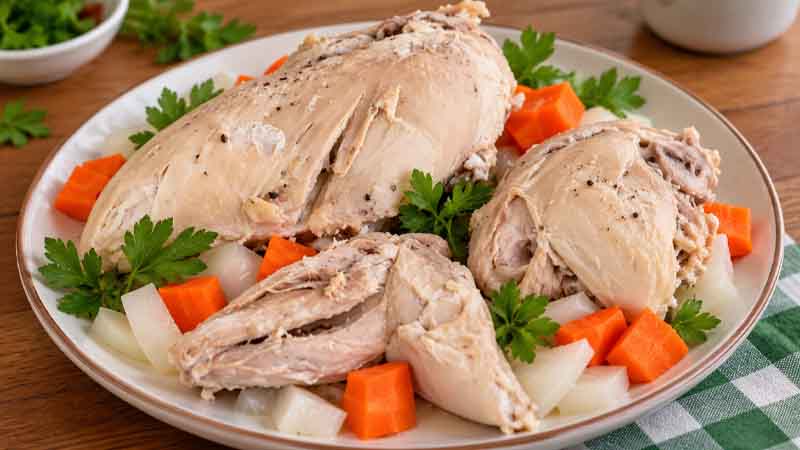
Boiling chicken breasts using a seasoned aromatic liquid instead of plain water is the key technique for producing juicy, tender meat.
This cooking method keeps the chicken breasts moist while simultaneously generating a rich, flavorful broth that can be saved for future dishes. This recipe outlines a simple, reliable approach designed specifically for boneless, skinless chicken breasts.
Recipe Overview and Quick Cooking Stats
| Cooking Metric | Detail |
|---|---|
| Prep Time | 5 minutes |
| Cook Time | 15–20 minutes |
| Total Servings | 4 servings |
| Target Internal Temperature | 165°F (74°C) |
With a quick preparation time of 5 minutes and an active cooking time between 15 and 20 minutes, this recipe yields 4 servings.
Required Ingredients and Exact Measurements
Selecting the proper ingredients and aromatics ensures the chicken develops balanced flavor throughout the boiling process.
- Chicken: 4 large boneless, skinless chicken breasts (approximately 7 to 8 ounces each).
- Cooking Liquid: 3 to 4 cups of low-sodium vegetable broth, low-sodium chicken broth, or water.
- Fresh Aromatics:
- 1 yellow onion, quartered
- 3 garlic cloves, smashed
- 1 stalk celery, chopped
- Seasonings:
- 1 teaspoon whole black peppercorns
- 1 teaspoon kosher salt
- 1 bay leaf
Recommended Kitchen Tools and Equipment
Having the correct kitchen equipment helps maintain consistent heat and allows for accurate food safety checks.
- Large Stockpot: A pot wide enough to hold 4 chicken breasts flat along the bottom.
- Tight-Fitting Lid: Essential for trapping steam and maintaining a gentle low simmer.
- Digital Meat Thermometer: Required to measure the internal temperature at the thickest section of the breast.
- Kitchen Tongs: Used to safely transfer hot chicken from the simmering liquid.
- Cutting Board and Forks: A steady surface for resting meat and two forks for shredding.
- Fine Mesh Sieve: Necessary for straining out solid aromatics and peppercorns from the finished broth.
Step-by-Step Cooking Instructions
Step 1: Combining the Ingredients in the Pot
Begin by placing the 4 chicken breasts flat across the bottom of a large stockpot. Add the quartered yellow onion, smashed garlic cloves, chopped celery stalk, whole black peppercorns, kosher salt, and bay leaf directly around the chicken.
Pour in 3 to 4 cups of broth or water until the chicken breasts are completely submerged by about one inch.
Step 2: Bringing the Liquid to a Rolling Boil
Place the covered or uncovered stockpot on the stovetop over medium-high heat. Watch the pot until the liquid reaches a full, rolling boil.
Step 3: Reducing Heat to a Gentle Simmer
As soon as the liquid achieves a rolling boil, immediately turn the heat down to low. Cover the pot tightly with a tight-fitting lid. Allow the chicken to gently simmer covered over low heat.
Step 4: Monitoring Internal Temperature
Simmer the chicken breasts for 12 to 15 minutes. Insert a meat thermometer into the thickest part of the chicken breast to check for doneness. The chicken is safely cooked when it reaches an internal temperature of 165°F (74°C).
Step 5: Resting and Shredding or Slicing
Use kitchen tongs to remove the chicken breasts from the stockpot. Transfer the breasts to a cutting board and let them rest for 10 minutes.
Resting for 10 minutes allows the internal juices to redistribute throughout the meat, preventing it from drying out. Once rested, slice, cube, or shred the chicken using two forks depending on your meal plan.
Essential Pro-Tips for Recipe Success
Avoiding Overcooked and Rubbery Texture
Boiling chicken on high heat for too long causes the protein fibers to contract tightly, producing a rubbery texture. Keeping the stovetop setting on low heat maintains a gentle simmer, ensuring the meat remains soft and tender.
Straining and Preserving the Cooking Broth
Do not throw away the liquid remaining in the pot after cooking. Pour the liquid through a fine mesh sieve to catch the cooked onion, garlic, celery, peppercorns, and bay leaf.
The strained liquid forms a flavorful broth that can be stored and used as a base for future soups, stews, or rice dishes.