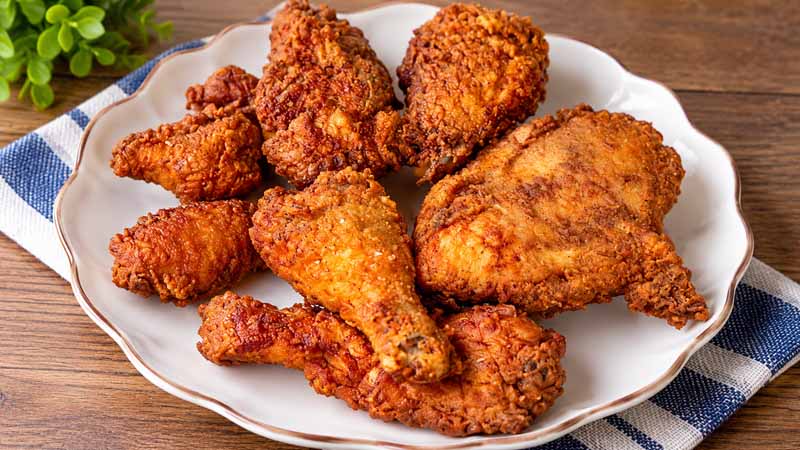
Marinating chicken in a mixture of hot pepper sauce and buttermilk tenderizes the meat while injecting spice into every bite.
This detailed guide provides the complete process for preparing Classic Spicy Southern Fried Chicken, covering ingredient ratios, step-by-step cooking procedures, exact frying temperatures, and techniques for achieving a crisp crust.
Recipe Overview and Key Metrics
Before beginning preparation, review the key time requirements, serving yields, and cooking parameters:
| Metric | Specification |
|---|---|
| Prep Time | 20 minutes |
| Marinating Time | 2 hours minimum |
| Cook Time | 35 minutes |
| Yield | 10 pieces |
| Difficulty Level | Medium |
| Target Oil Temperature | 350°F (175°C) |
| Safe Internal Chicken Temperature | 165°F (74°C) |
Ingredients List
To execute this recipe accurately, gather and measure the ingredients for both the marinade and the dry coating.
1. The Buttermilk Marinade
- 1 (3-pound) whole chicken: Cut into 10 pieces.
- 1 quart buttermilk: Acts as the liquid base for tenderizing the meat.
- 2 tablespoons hot pepper sauce: Adds heat throughout the marinating process.
- 1 teaspoon cayenne pepper: Adds additional spice to the liquid mixture.
- Salt and ground black pepper: Added to taste.
2. The Seasoned Flour Dredge
- 3 cups all-purpose flour: Forms the primary dry coating.
- 1 tablespoon cayenne pepper: Blends into the flour for exterior heat.
- 2 teaspoons garlic powder: Adds savory seasoning to the flour mixture.
- 1 teaspoon paprika: Enhances flavor and color in the crust.
- Salt and ground black pepper: Added to taste.
- Vegetable oil: Required in sufficient quantity for deep frying.
Required Cooking Tools and Equipment
Having the correct equipment prepared ensures smooth execution during frying:
- Deep-sided baking dish: For holding the chicken pieces during marinating.
- Large bowl & whisk: For combining the liquid marinade ingredients.
- Plastic wrap: To cover the baking dish while refrigerating.
- Large resealable plastic bag: For mixing the flour dredge and coating the chicken.
- Deep fryer or large, heavy saucepan: For heating the frying oil.
- Instant-read thermometer: For verifying oil heat and internal chicken temperature.
- Slotted spoon or tongs: For transferring chicken into and out of the hot oil.
- Paper towels & plate: For initial draining of fried chicken.
- Wire cooling rack & oven: For keeping cooked pieces warm in batches.
Step-by-Step Cooking Instructions
Follow these numbered steps in sequence to prepare, coat, and fry the chicken correctly.
Step 1: Season and Prep the Chicken
Begin by arranging the 10 chicken pieces in a deep-sided baking dish. Sprinkle salt and ground black pepper generously over all pieces of the chicken.
Step 2: Mix and Apply the Marinade
In a large bowl, whisk together 1 quart of buttermilk, 2 tablespoons of hot pepper sauce, and 1 teaspoon of cayenne pepper until fully integrated.
Pour the entire buttermilk mixture over the chicken in the baking dish, confirming that all sides of each piece are submerged or coated.
Cover the dish tightly with plastic wrap and place it in the refrigerator to marinate for a minimum of 2 hours.
Step 3: Prepare the Seasoned Flour Coating
Take a large resealable plastic bag and add 3 cups of all-purpose flour, 1 tablespoon of cayenne pepper, 2 teaspoons of garlic powder, 1 teaspoon of paprika, along with salt and ground black pepper to taste.
Seal the bag and shake thoroughly to distribute the spices evenly throughout the flour.
Step 4: Dredge the Chicken Pieces
Remove chicken pieces from the buttermilk mixture individually, shaking them gently to discard excess liquid. Place 2 to 3 pieces of chicken at a time into the resealable plastic bag containing the flour coating.
Seal the bag and shake vigorously until every piece is completely covered in the seasoned flour dredge. Repeat this process in small batches for all pieces.
Step 5: Heat the Cooking Oil
Pour vegetable oil into a deep fryer or a large, heavy saucepan. Set the burner to heat the oil until it reaches a steady temperature of 350°F (175°C), monitoring the temperature with an instant-read thermometer.
Step 6: Fry White and Dark Meat Pieces
Lower the floured chicken pieces carefully into the heated oil without overcrowding the vessel. Adjust cooking times based on whether you are frying white meat or dark meat pieces:
- White Meat (Breasts and Wings): Fry for 8 to 10 minutes.
- Dark Meat (Thighs and Drumsticks): Fry for 13 to 15 minutes.
The chicken is fully cooked when the outer coating turns a rich golden brown and an instant-read thermometer inserted into the thickest part reads an internal temperature of 165°F (74°C).
Step 7: Drain and Serve
Using tongs or a slotted spoon, lift the cooked chicken out of the hot oil. Transfer the pieces onto a plate lined with paper towels to drain off residual surface oil. Serve the fried chicken hot.
Pro Techniques for Maximum Crust Crunch
Incorporating these specific steps during preparation improves the texture and temperature stability of the final crust.
[1. Counter Rest (10-15 min)] ──► [2. Optional Double-Dip Dredge] ──► [3. Fry at 350°F] ──► [4. Oven Warming at 200°F]
1. Temperature Stabilization Before Frying
Allow the marinated chicken to sit on the counter at room temperature for 10 to 15 minutes prior to dredging and frying. Adding cold chicken directly from the refrigerator causes the hot oil temperature to drop rapidly, which leads to a soggy crust.
2. The Double-Dip Dredging Method
For a thicker and extra crisp exterior crust, implement a double-coating sequence:
- Pass the chicken through the seasoned flour dredge.
- Dip the floured piece back into the buttermilk marinade for a split second.
- Place the piece back into the resealable flour bag and shake a second time before placing it into the oil.
3. Oven Holding Method for Batch Frying
When cooking multiple batches, maintain crispness and heat by placing finished pieces on a wire cooling rack positioned inside an oven set to 200°F (95°C).
Resting chicken on a wire rack prevents moisture accumulation underneath the crust while keeping it warm.
Complete Summary & Cooking Parameter Guide
The table below summarizes all essential elements of the recipe for easy reference during cooking:
| Category | Item / Action | Specific Detail |
|---|---|---|
| Meat | Whole Chicken | 1 (3-lb) whole chicken cut into 10 pieces |
| Marinade Base | Buttermilk | 1 quart |
| Marinade Spices | Hot Pepper Sauce & Cayenne | 2 tbsp hot pepper sauce + 1 tsp cayenne pepper |
| Marinating Time | Chill Duration | Minimum 2 hours in refrigerator |
| Dredge Base | All-Purpose Flour | 3 cups |
| Dredge Seasoning | Cayenne, Garlic, Paprika | 1 tbsp cayenne + 2 tsp garlic powder + 1 tsp paprika |
| Rest Period | Counter Rest | 10 to 15 minutes before frying |
| Frying Medium | Vegetable Oil | Heated to 350°F (175°C) |
| White Meat Time | Breasts & Wings | 8 to 10 minutes |
| Dark Meat Time | Thighs & Drumsticks | 13 to 15 minutes |
| Doneness Check | Internal Temp | 165°F (74°C) on instant-read thermometer |
| Holding Method | Oven Temperature | 200°F (95°C) on a wire rack |