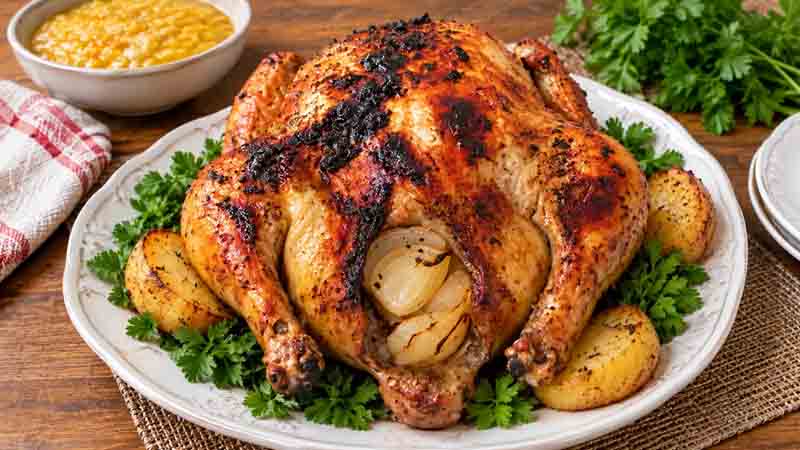
Roasting a whole chicken at a lower temperature over several hours is one of the most reliable ways to achieve exceptionally juicy, tender meat that effortlessly falls away from the bone.
By utilizing a gentle low-and-slow oven method, you allow the fats in the bird to render completely while rich flavors deeply infuse throughout every layer.
This comprehensive recipe guide breaks down the simple prep work, herb seasonings, pan liquids, and slow-cooking techniques required to master this recipe.
Recipe Overview and Prep Details
Before getting started, here is a quick snapshot of the timing, yield, and cooking parameters for this recipe:
- Prep Time: 15 minutes
- Cook Time: 4 to 5 hours
- Rest Time: 10 minutes
- Total Time: Approximately 4 hours 25 minutes to 5 hours 25 minutes
- Servings: 4 to 6 people
- Cooking Method: Low-and-Slow Oven Roasting
- Oven Temperature: 250°F (120°C)
Key Ingredients Needed
This recipe relies on simple ingredients divided into three core components: the bird, the cavity aromatics, and the herb rub paste.
1. The Bird and Cavity Aromatics
- Whole Chicken: 1 whole chicken weighing 4 pounds, with the giblets completely removed.
- Yellow Onion: 1 medium yellow onion, cut into quarters.
- Celery: 3 to 4 stalks of celery, cut in half.
- Red Wine: 1 cup of red wine, which is poured directly into the bottom of the roasting pan to add rich moisture during the long roast.
2. The Herb Rub Paste
To season the exterior of the bird, you will mix a thick seasoning paste using six key pantry staples:
- Olive Oil: 3 tablespoons.
- Garlic Salt: 1 teaspoon.
- Paprika: 1 teaspoon.
- Dried Thyme: 1 teaspoon.
- Dried Parsley: 1 teaspoon.
- Ground Black Pepper: 1 teaspoon.
Essential Kitchen Equipment
To successfully execute this slow roast, gather the following kitchen items:
- Roasting Pan with Cover: A standard roasting pan fitted with a tight-fitting lid (or heavy-duty aluminum foil).
- Small Bowl: For blending the oil and spices into a uniform rub.
- Paper Towels: For patting the chicken dry to ensure the herb paste adheres properly.
- Instant-Read Meat Thermometer: To verify internal temperature accuracy.
- Serving Platter & Foil: For resting the chicken prior to carving.
Step-by-Step Cooking Instructions
Follow these clear, sequential steps to prepare and slow roast your whole chicken.
Step 1: Preheat the Oven and Prepare the Roasting Pan
Begin by preheating your oven to 250°F (120°C). Take your roasting pan and pour 1 cup of red wine directly into the bottom.
The red wine provides a continuous supply of steam and rich moisture inside the covered pan throughout the multi-hour roasting process.
Step 2: Mix the Herb Rub Paste
In a small bowl, combine 3 tablespoons of olive oil, 1 teaspoon of garlic salt, 1 teaspoon of paprika, 1 teaspoon of dried thyme, 1 teaspoon of dried parsley, and 1 teaspoon of ground black pepper. Stir the ingredients thoroughly until a smooth herb paste forms.
Step 3: Season the Chicken Exterior
Unwrap the 4-pound whole chicken and ensure the giblets are removed. Pat the chicken completely dry on all sides using paper towels. Drying the skin allows the seasoning paste to cling effectively.
Scoop up the herb paste and rub it all over the outside of the chicken, making sure to coat every crevice evenly.
Step 4: Stuff the Cavity and Position in Pan
Take the quartered medium yellow onion and the 3 to 4 halved celery stalks and place them inside the cavity of the chicken. Transfer the stuffed chicken into the roasting pan, positioning it breast-side up directly over the red wine.
Step 5: Cover and Slow Roast
Cover the roasting pan tightly with its matching lid. If your roasting pan does not have a lid, cover it tightly with a double layer of heavy-duty aluminum foil to trap all heat and steam. Place the pan in the preheated oven and bake at 250°F (120°C) for 4 to 5 hours.
Step 6: Test for Doneness
After 4 hours, check the chicken for doneness. The chicken is fully cooked when the juices run completely clear and an instant-read meat thermometer inserted into the thickest part of the thigh reads between 165°F and 180°F (74°C to 82°C).
Step 7: Optional Technique for Crispy Skin
If you prefer a golden brown, crispy skin rather than soft skin, uncover the roasting pan during the final 15 to 20 minutes of cooking. Turn the oven setting up to broil and monitor the bird closely until the skin browns to your desired crispness.
Step 8: Rest and Serve
Carefully remove the chicken from the roasting pan and transfer it to a serving platter. Tent the chicken loosely with aluminum foil and allow it to rest for 10 minutes before carving.
Resting permits the meat juices to redistribute and lock into the fibers so every bite remains moist.
Cooking Tips for Slow Roasting Success
To guarantee a seamless cooking experience, keep these targeted tips in mind:
- Maintain a Tight Seal: Ensuring the roasting pan lid or double foil wrapping is securely sealed prevents moisture from escaping during the 4 to 5 hour roast.
- Use an Instant-Read Thermometer: Always measure the internal temperature in the thickest section of the thigh without touching the bone to confirm it falls in the 165°F to 180°F (74°C to 82°C) target range.
- Do Not Skip Resting: Carving the chicken immediately after pulling it from the oven will cause natural juices to leak onto the board; resting for 10 minutes preserves tenderness.